For discussion about setting up your studio and advice on the gear and equipment within it.
User avatar
By mr_debauch Thu Dec 20, 2012 5:22 pm
RootsRenegade wrote:
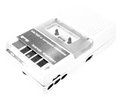
mr_debauch wrote:yeah I could use a tape deck like that... would be cool if there was a model that took two cassettes and recorded 8 tracks at once without bouncing to 4 tracks (not sure how they have that set up)


It can record 8 tracks simultaneously.


sure, but the cassette only has 4 actual tracks.. right? not sure how that works (physically) ... pretty sweet looking machine none the less.
User avatar
By tapedeck Thu Dec 20, 2012 5:26 pm
it is actually an 8 channel head

the tape is just blank tape - no such thing as a 'track'.

the head physically records / divides the tape into however many tracks it is designed to do - they get smaller as track count goes up. this machine is recording on tracks 1/2 the width of normal cassette tracks.

truly a unique machine.
User avatar
By mr_debauch Thu Dec 20, 2012 5:32 pm
tapedeck wrote:it is actually an 8 channel head

the tape is just blank tape - no such thing as a 'track'.

the head physically records / divides the tape into however many tracks it is designed to do - they get smaller as track count goes up. this machine is recording on tracks 1/2 the width of normal cassette tracks.

truly a unique machine.


ah cool.. nice info... I was always under the assumption that cassette tapes were 4 tracks and those machines made use of all 4 in one direction. I been meaning to use my fostex for some projects but never got around to it lately.
User avatar
By tapedeck Thu Dec 20, 2012 5:38 pm
mr_debauch wrote:ah cool.. nice info... I was always under the assumption that cassette tapes were 4 tracks and those machines made use of all 4 in one direction. I been meaning to use my fostex for some projects but never got around to it lately.

yer half correct once you realise it's in the head, not the tape.

looking at the bottom of a cassette vertically, a 4 track has record / play heads like this:
****

a regular tape deck has two heads like this:
**--

it only records on half the tape, you flip it to record on the other.

you should bust out the 4 track dude - perfect for your style. record some bs to the machine, send it to me and send you a remix album and yer machine back.
i love mixing on those things.
User avatar
By mr_debauch Thu Dec 20, 2012 5:45 pm
tapedeck wrote:
you should bust out the 4 track dude - perfect for your style. record some bs to the machine, send it to me and send you a remix album and yer machine back.
i love mixing on those things.


haha, my co producer actually owns that piece but it stays at my lab since he doesn't have a studio setup... he starts projects on his laptop and we finish the work when we transfer everything to the main computer at my spot.... we have out sample DB here... but he plays instruments etc... and has been talking lately about taking the 4 track back for a bit to do some sh!t on it because he really loves that thing and makes some odd noise with it. last thing I did with it was on that beat tape project I put out last year... so it's been a few years since I put it to use. I dont think he has used the machine in at least 6 years... maybe more.

I never really use the type 2 tapes with the thing... just regular ones... so by the 3rd song... it starts warping and some parts get pretty stretched out hahaha.
User avatar
By dabmeister Fri Dec 21, 2012 10:11 am
The Tascam 488 allowed a max of four tracks at a time. It lacked a lot of features the 688 has.

I use to stripe track 8 with midi sync so I could have my external sequencers follow suit (a built in feature of the 688, which is why it's called MIDISTUDIO).

The only drawback to this...if material on track 7 is recorded too loud, it will affect the sync signal on track 8 and cause the slaved sequencers to drop in & out.
By Roots Renegade Fri Dec 21, 2012 11:47 am
tapedeck wrote:
RootsRenegade wrote:I take the time to "arrange my tracks" while the MPC is looping (with the 688's record function buttons alight so the mixer affects the 8 inputs and i can monitor the GRP/TRK 1-8 meters, adjusting the levels and tape compression levels on individual tracks) instead of rewinding my tape, playing it, re-rewinding it, re-playing it while adjusting the mixer.

that's what i thought you were doing - unless you have the tape signal routed to the group outs, and the tape is running, you are actually bypassing the tape altogether.

if the tape is running, and the TAPE (not the channel) is routed to the group outs, then you will get the tape effect - after a short delay (physical location of the playback head is after the record head...distance = delay).

so if you are really just monitoring the mix with the record buttons enabled, you are not getting any 'tape' effect at all.

to do that, you record to tape first, then go back (rewind) and do a mixdown.

if you are somehow monitoring the actual tape output while the tape is actually running, that's cool though. how do you cope with the delay?


What i do is let the MPC play while i "arrange" each track individually on the 688's mixer. When i am done with the arrangements (EQ, levels, etc), i play the MPC one last time but this time, i record it to tape (and yes, before you ask me again, the mixer DOES affect the signal coming in from the MPC WHILE recording to tape).

Once it is recorded to tape, i track it out (from tape) to DAW (my soon to be made tests will tell me if i go group or tape outs but for the moment, i believe i will have to go tape outs to keep my 8 individual channels separated one from each other once in DAW), on 8 different channels, so each track is individually recorded to DAW.

What delay ? I track out tape's 8 channels through the group/tape outs, that's all.

Man, it is not that complicated. I was just asking how to record the mixer's panning on tape...

also i might have been incorrect - maybe the 8 outs on a 2500 are balanced - apparently the site says one thing but the service manual says another.


Correct, the 8 outs on the MPC2500 are balanced. It is written black on white in the manual's specifications section (page 117).

still for this application, i dont think it's going to make any difference what cable you use.


I said that i want to keep the signal balanced for as far as posible in my setup chain (cable from interface to 688, knowing that coming back to interface, the 688's outs are unbalanced), to minimise the possiblities of picking up noise in the cables run.

I didn't ask if it was going to make a difference, i asked if someone could confirm if the 688's Line B input (1/4 phone jack x 10) are/are not balanced.

From the 688's service manual specifications section:

ELECTRICAL CHARACTERISTICS

Mixer section

Line B input (1/4 phone jack x 10)
Input Impedance........20k ohms
Nominal Input Level........ -10 dBV (0.3 V)
Maximum Input Level....... +12 dBV (4.0 V)

Can someone please confirm if those Line B 1/4 phone jack inputs are balanced or unbalanced? I want to plug my audio interface's balanced/unbalanced outputs to those 688's line ins so i need to confirm what cables i have to buy.

User avatar
By dabmeister Fri Dec 21, 2012 12:08 pm
RootsRenegade wrote:Can someone please confirm if those Line B 1/4 phone jack inputs are balanced or unbalanced? I want to plug my audio interface's balanced/unbalanced outputs to those 688's line ins so i need to confirm what cables i have to buy.


They're unbalanced. If you need a better quality signal, I would go through some sort of pre amp (or DI) first since the 688 doesn't have a on board pre.

Something that would fit that script would be for example...an aphex 207D (which I use) or an decent 8 channel pre. Although the aphex is a two channel mic pre/DI interface, it will do what I need it to do...just that it will take a little longer with multiple tracks.

It will be in your best interest to use a pre instead of utilizing the stock balanced connections on the 688...that's just my opinion.
By Roots Renegade Fri Dec 21, 2012 2:37 pm
Thanks, but...

dabmeister wrote:They're unbalanced.


dabmeister wrote:... the stock balanced connections on the 688...


:hmmm: Unbalanced or stock balanced connections on the 688 ? :hmmm:

Ok ok, unbalanced :lol:

Also,

dabmeister wrote:If you need a better quality signal, I would go through some sort of pre amp (or DI) first since the 688 doesn't have a on board pre.


:hmmm: Isn't the function of a pre amp to amplify the signal from mic level to line level ?

My interface (MOTU 828 MK3 hybrid) has line level outs, not mic level. Do i really need a pre amp to go from line level outputs to line level inputs ? I don't see why i would need one. Line level signals don’t need to be amplified by a preamp. They are already at the appropriate level.

Image

Image

what would be the purpose/benefit of a pre amp in my situation ?
User avatar
By dabmeister Fri Dec 21, 2012 5:46 pm
The way that I see things if I were in a situation such as yourself, I'd have both balanced and unbalanced cables in both xlr and 1/4 in. (which btw I do have both types in my accessories box). And in this day and time, anybody that takes this stuff seriously will have all of this stuff on hand and not just one or the other.

This way if you're not sure of something you can check out what will work and what doesn't.

So with that being said, I wouldn't worry about the little things because you waste more time dealing with something that isn't all that from the get go.

Just grab both types of cables and experiment until you find what you're after.

Image

Image

Image

Image

Image

Image

Image
By Roots Renegade Fri Dec 21, 2012 6:11 pm
dabmeister wrote:The way that I see things if I were in a situation such as yourself, I'd have both balanced and unbalanced cables in both xlr and 1/4 in. (which btw I do have both types in my accessories box). And in this day and time, anybody that takes this stuff seriously will have all of this stuff on hand and not just one or the other.

This way if you're not sure of something you can check out what will work and what doesn't.

So with that being said, I wouldn't worry about the little things because you waste more time dealing with something that isn't all that from the get go.

Just grab both types of cables and experiment until you find what you're after.


I agree, thanks. :)
User avatar
By dabmeister Fri Dec 21, 2012 9:19 pm
RootsRenegade wrote:Did you just take those pictures ?


Well actually those pics were taken earlier this year. But these are the cables I use with my setup.
User avatar
By invhide Fri Feb 06, 2015 8:58 am
Yo! I'm taking this thread out of the abyss, because I'm a Tascam 688 user and I've seen other threads talking about the 688 around here. Maybe we could share knowledge about this piece of gear that I personally love. I hope I'll find some 688 friends here.

This is how I use it for now, but I'd like to go a bit deeper and there are so much things that I don't understand, even with the manual.. Routing is still a nightmare for me, so I just use what I know for now..

- I usually send 4 outs of my SP and 4 outs of my s950 to the 8 input jack. I'm using a cordial cml 8-0 vv 3 c
- I have the 688 wired to a mackie mixer via the monitor out cinch
- I ruffly adust my volume on the sp/s950 (so all my faders will be around 7-8)
- I make all my sequences on the sp
- I EQ each track
- Then I recod to tape on 8 separate channels (modified scene 10 for LINE inputs)
- Put everything at 12 o'clock, Play the tape back, Pan and sometimes EQ a bit again (mostly filtered basslines)
- Track out from monitor outs to DAW. (scene 8 if I'm correct)
- Also often use the channels 9 or 10 for: SP metronome and dj mixer (turntables) that I will not record.

I just got an M-audio 2626 now and this will allow me to track the 8 group outs to DAW for adding effects, compression, or even change the song arrangement if I feel like doing it.

Do you guys use some external effects with the 688? I don't understand how many effects I can use with this thing. I guess I would use compression, reverb and delay most of the time, so I'm wondering if it's worth investing in hardware effects.

Have someone managed to record midi on track 8 and then record the midi signal to DAW? I really have no idea how to do it, and if it would be useful..

What level do you usually record at? I usually make a mix that will be just below the max level on the meters when recording, and the same for the mixdown.

I wonder how I could use the dual inputs. I don't really see the point of it. Might be useful for the SP metronome..

Looking forward for some comments and replies :-D
User avatar
By derMole Fri Feb 06, 2015 10:12 am
invhide wrote:Do you guys use some external effects with the 688? I don't understand how many effects I can use with this thing. I guess I would use compression, reverb and delay most of the time, so I'm wondering if it's worth investing in hardware effects.


Most of what I'm writing now is common mixing knowledge but you may find something that helps you:

The "standard" ways to apply effects to your mix are:

1. Inserts: Each channel has an insert jack. Inserts are used for effects that change the original signal (like compression, de-essing) and/ore are dedicated to this channel.
2. AUX: The 688 has two AUX busses. These are used for effects that are used by multiple channels (like reverb, delay, modulation effects).

The number of effects you can use is basically limited by the number of effect units you got.
Let's assume you have a dual channel multi effect unit and a dual channel compressor. A setup could be something like this:

Channel 1: Kick
Channel 2: Snare (Post-Fader AUX1)
Channel 3: HiHats (Post-Fader AUX1)
Channel 4: Bass (Insert: Compressor)
Channel 5: Sample 1 (Insert: Compressor, Post-Fader AUX1)
Channel 6: Keys (Post-Fader AUX1, Post-Fader AUX2)
AUX 1: Reverb
AUX 2: Delay


Parallel Compression (aka New York Compression)

Put your compressor on one AUX.
Set the AUX send on the channel(s) to pre-fader.
Adjust AUX return.


Buss Compression Workaround

Often you want to compress multiple channels together (like drums). Unfortunately the 688 does not have group inserts. You can work around this by using the compressor similar to the parallel compression technique. The difference is that you pull your channel faders down and have to adjust the pre-fader levels to the amount the faders have been.