Gonna sum up my thoughts here.
Third party plug-ins seem very unlikely to me l, as much as I would welcome them. As somebody else mentioned, the security implications and limited market for Linux-based plug-ins on a niche device make it unlikely to me that an App Store model makes any business sense on paper for Akai.
For anybody complaining about paying for plug-ins: come on, guys. I bought my MPC Live mki in late 2019. I was in love with the feature set I bought it with, and Akai has given me several great OS releases since then which made the machine so much more than what I first bought: external midi and audio interface support (albeit buggy with certain audio interfaces), DrumSynth and Hype and all the other free plug-ins, and so on. I would have happily paid to upgrade to the plug-ins along the way. Akai needs a business incentive to keep developing this platform. If I have to throw a few hundred $ at them every year to keep the devices fresh and powerful by paying for plug-ins, that seems like a fair trade. And if you don’t want to pay for those plug-ins, then don’t buy them.
I would personally love to see a Virus TI2 Polar style MPC Live with a 37-key keyboard. It would be the best of both worlds in terms of portability. At 61 keys, the MPC Keys keyboard is already so large that getting a carrying case that can also hold an MPC Live is kind of a trivial addition, and for that scenario I’d rather pick a best-in-class MIDI keyboard controller to pair up with a Live, so I can’t say the all-in-one giant keyboard on the MPC Keys really appeals to me all that much. I used to love running my Virus TI on my desk next to my Mac back in my DAW days - 37 keys was the sweet spot for size and key range IMO.
I’d absolutely flip if they made a 37-key device with Force-style pads to get more pads on the front panel. I prefer the Force’s pads to the MPC, having owned both devices for some time now. The Force’s clear pads work really well for use cases like step sequencing which I think would really shine on a workstation-style device like this. It kind of blows my mind that they didn’t base the keyboard model on the Force OS with the arranger etc., or at least put the arranger into the MPC OS already with 2.11 or a new 3.0 release. A keyboard version of the MPC or Force with the arranger would be a true workstation IMO.
It really warms my heart to see a ribbon controller on the Keys. I wish they’d taken a tip from their Alesis roots and reintroduced the giant double-sided ribbon from the Andromeda. That’s my favorite ribbon controller ever, and the switchable hold feature on it is really cool as well as the ability to treat it like two discrete ribbons.
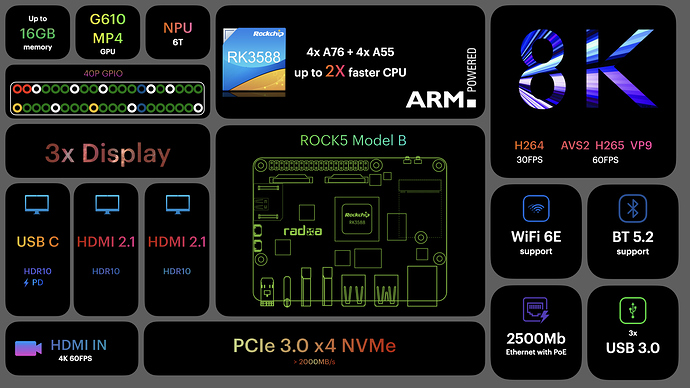
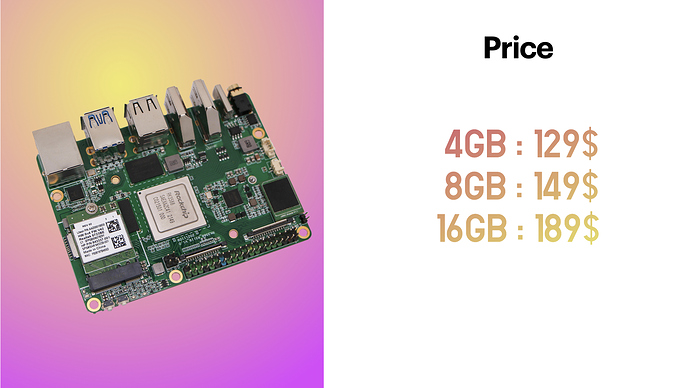
As far as the SoC goes: once again, I’d bet money this is built on the same Radxa Rock2 board with the 4GB option (
https://www.cnx-software.com/2014/11/05 ... fications/) and not the newer Rock5. The fact that this device is still capped at a max of eight plug-ins and audio tracks implies that there’s no additional CPU horsepower. I’d say it’s only a matter of time before Akai upgrades the whole lineup to a more modern board but there seems to be little reason for them to do so for this keyboard alone. All a board upgrade would do is add to their support and maintenance burden, and I’m sure they’re not ready to take that burden on just yet. As others have said elsewhere, that extra 2GB of RAM is probably for larger key groups for piano samples etc.
If and when Akai upgrades to the new Rock5 boards or similar, going to the support for NVMe SSDs over SATA will make an enormous improvement. I’d liken NVMe to “slow RAM” versus SSDs, which on the SATA protocol are more like “fast HDDs”. The possibilities for incredibly fast disk streaming and even live playback of samples via super low-latency NVMe drives with hundreds of thousands of iops would be amazing, almost like having unlimited RAM.



 MPC-Tutor wrote:Damn, they did it, upgraded ram.






 to Native Instruments Komplete Kontrol S61

 The Fantom/Motiff lines are the epitome of preset synth sounds. In my original reply that you quoted, I explicitly call out the ability to craft your own sound on the MPC ecosystem as its differentiating factor.